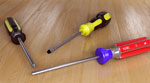
Screwdrivers belong between the objects which are used daily in our life and could be called common. In this tutorial I decided to model three different types of screwdrivers where every single one has a different handle and a different tip. The objects are quite simple but they are ideal for modelling practice. At first we will place our reference images inside 3ds Max and prepare the environment for modelling. For proper rendering we will change the units with which we are working from generic one to centimetres. By all three screwdrivers we will start our modelling process from a primitive which will serve as a starting piece. In our case and because all screwdrivers have a cylindrical shape, our starting primitive is a simple cylinder with a small amount of sides. The small amount of sides will allows us to properly control the screwdriver shape and his details. After fitting our primitive on our reference image we will convert the object to „editable poly“ and start using the editable-poly technique for modelling all details on our screwdriver. Using the functions such as loop, connect, extrude, bevel and similar we will achieve a smooth and identical model as on our reference images. Because our model is modelled from a cylinder with small amount of sides, at the end we will use a smoothing modifier to smooth our model.
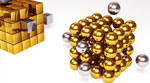 Recently I was confronted with one question from our users regarding a picture made from small boxes which were forming a larger box together with reflective material to this surface. The overall modelling by this case isn’t any problem and the inbuilt array function will create this kind of object without problems but the reflections on this flat surface is a different story. But let’s take it step by step. The inbuilt array functions inside 3ds Max is used for creating one-, two-, and three-dimensional arrays. For example, a row of five objects is a single-dimension array, even though it takes up three-dimensional space in the scene. An array of objects that's five rows by three columns is a two-dimensional array, and an array of objects that's five rows by three columns by two levels is a three-dimensional array. As you can see, using this function you can create very simple but also very complex objects where repeating of the same objects is required.